Enables Lumerical tools to interact with each other, third-party applications, and a rich set of Python content
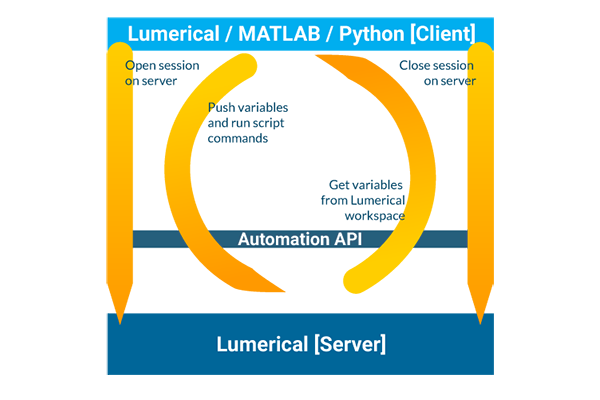
The Automation API, which is accessible via Python, enables users to perform powerful custom analyses, undertake enhanced optimization and visualization, produce publication-quality plots, and automate complex workflows
Python-Driven Interoperability
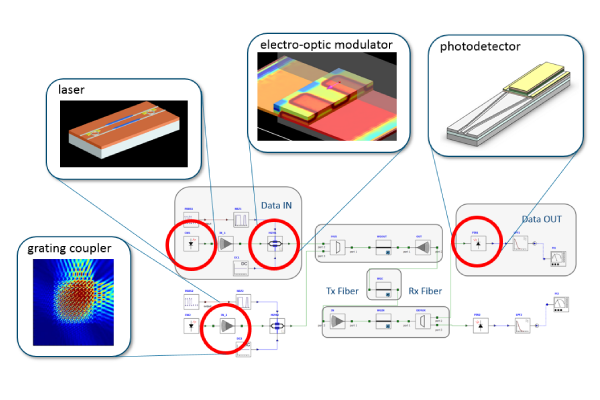
Build, run, and control simulations across multiple Lumerical tools, or interface Lumerical tools with third-party applications
Use a single file to run optical, thermal, and electrical simulations before post-processing the data in Python
Take advantage of the rich open-source projects available within the Python photonics community
Indispensable for the Photonics Python Community
Take advantage of the many benefits of using Python:
Make use of an extensive set of Python libraries in the fields of numerical analysis, visualization, optimization and more
Leverage special, purpose built applications for photonic designers
Use the well-known Python language to build your own in-house integrations and applications
Automation Enables Inverse Design
Take advantage of Inverse Design, a new capability made possible via Lumerical’s Automation API:
Based on an open-source implementation of the Adjoint Method packaged within FDTD Solutions, available on GitHub
Automatically discover optimal geometries for a desired target performance